Meta Muse Is Here. What It Means for Your Business (From a Company Building in the Same Space)
Meta launched Muse this week, a personal AI agent that doesn't just answer questions but acts: sends emails, books travel, fills forms, and makes purchases with its own one-time-card wallet. We build in this space, so consider our bias disclosed — and our seat inside the category is also why we can read this launch clearly. The short version: Muse is built for your personal life, not your front office; its trust features (confirm-first approvals, forget controls) validate exactly what the whole agent category has been converging on; and the smartest thing a business owner can do this month is try Muse personally while judging business AI by a different checklist. Here's the honest breakdown.

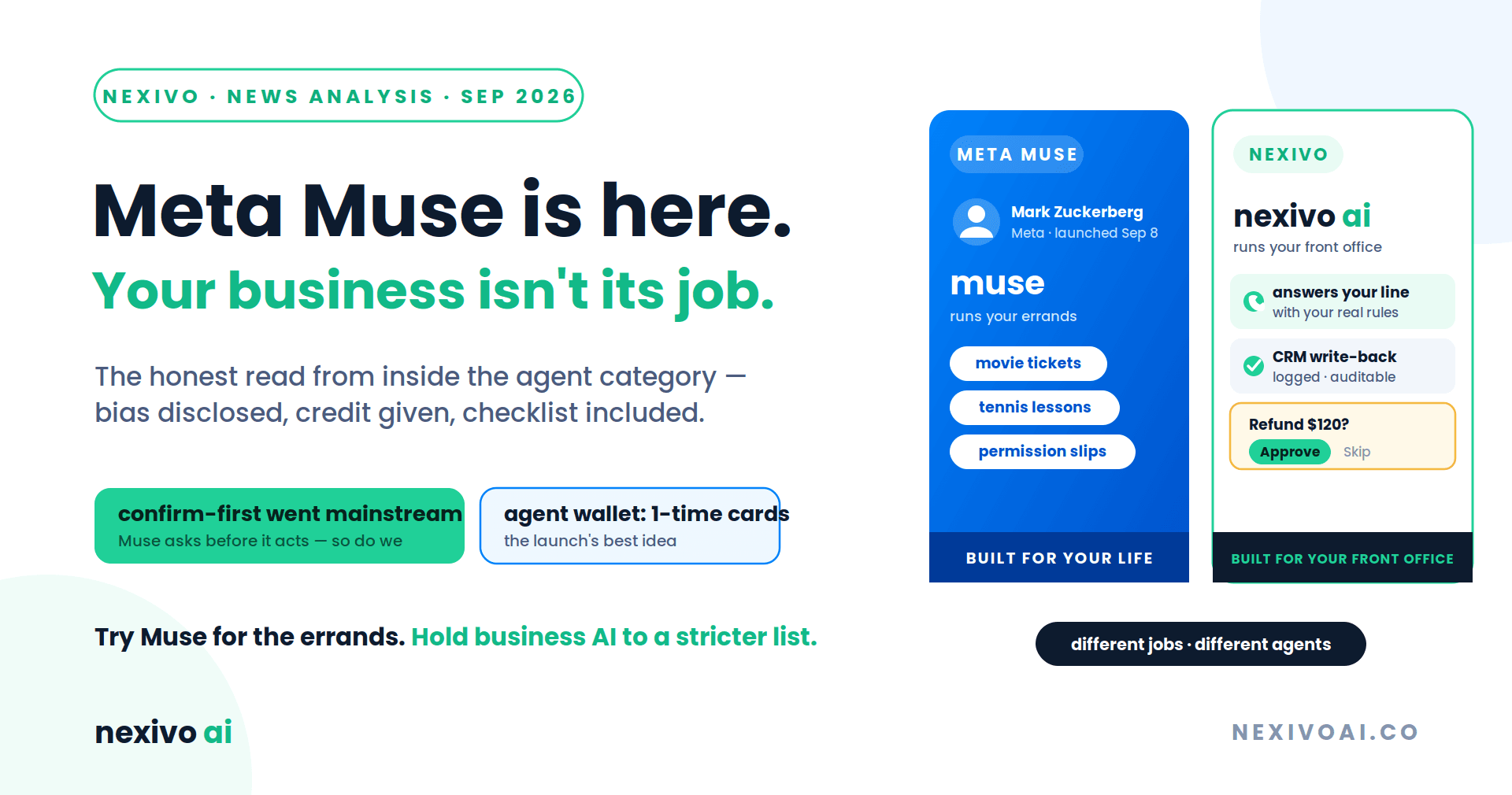
Meta launched Muse this week, a personal AI agent that doesn't just answer questions, it does things: sends emails, books travel, fills out forms, and makes purchases with its own one-time-use card. We should say this immediately: we build AI agents for businesses, so we're not neutral about this news. Read us with that in mind. But our seat inside the category is also why we can tell you the three things that matter: Muse is built for your personal life, not your front office. Its safety design, asking before it acts, memory you can wipe, confirms the pattern the whole agent industry has settled on. And the smartest move for a business owner this month is to try Muse for your errands while judging business AI by a different checklist. Here's the breakdown.
What Muse actually is
Strip the launch buzz, and Muse is this: an agent that takes a task, makes a plan, and keeps working even after you close the app. Meta's own examples are wonderfully ordinary: buying movie tickets, scheduling tennis lessons, filling out a permission slip for a class field trip, online shopping. You tell it what needs to get done; it figures out the steps.
The practical details, verified from launch coverage: it lives at muse.ai, in iOS and Android apps, and inside WhatsApp, with Meta's AI glasses next. It's free to start, though it asks for a payment card at signup, with paid tiers at $20/month (Power) and $100/month (Maximum) as usage grows. When it reaches a consequential step, like sending an email or completing a purchase, it comes back and asks you first. And for shopping, it uses Stripe's Link with a wallet built specifically for AI agents: every transaction gets a one-time-use card, and Muse is the first AI agent covered by Link's purchase protections.
Credit where it's due
A few things in this launch are genuinely well done, and pretending otherwise would tell you more about our bias than about Muse.
The agent wallet is the standout. One-time-use cards per transaction is exactly the right answer to "should an AI hold my credit card"; the blast radius of any mistake is one card, one purchase. We expect this pattern to become standard across the industry, and honestly, we're a little jealous Stripe and Meta shipped it first.
The memory controls are right too: Muse remembers context across tasks, but you can tell it to forget specific things, and you can opt out of your conversations training Meta's models. And a Confidential VM, encrypting the entire environment your agent runs in, is planned for later this year. These aren't decorations. They're real answers to real questions.
The part that made us smile
Here's the detail we keep coming back to: Muse asks before it acts. Before it sends the email. Before it spends the money. It plans freely, works autonomously, and stops at the consequential step for your approval.
If you've read this blog before, you know why we're smiling. Confirm-first approvals, scoped permissions, reversible actions- this is the trust architecture we've been writing about all year, and that we build into our own agents. When the largest consumer company on the planet launches its flagship agent and the safety story is "it checks with you first," that's not a coincidence. That's a category agreeing, in public, on what trustworthy agents look like. The debate about whether agents need approval checkpoints is over. Meta just ended it.
Now the important part: what Muse is not
Read Meta's example list again: movie tickets, tennis lessons, permission slips, shopping. Notice what's missing? Your business.
That's not a criticism; it's a product decision, and probably the right one for 3.6 billion consumers. But it means a business owner should be precise about what just launched. Muse is a personal-life agent. A business front office is a different animal:
- Your phone line needs an agent that answers every call with your actual scheduling rules: which staff take which services, which rooms are free, how family bookings stack, which patients can book with whom. Not "add it to my calendar"; run my calendar's logic.
- Your records need write-backs to a CRM, a booking system, a helpdesk, with an audit trail your team (or an auditor) can read.
- Your money needs reconciliation against real bank feeds and invoices, where "mostly right" is not a category that exists.
- Your accountability needs a contract. When something goes wrong with a customer, "the AI did it" isn't an answer; a vendor who owns the fix is.
None of that is what Muse launched to do, and stretching a personal agent over business workflows is how the "AI didn't work for us" stories of 2027 get written. Different jobs, different tools, different trust requirements.
The trust question, asked fairly
We won't throw stones here; our incentive to is exactly why we shouldn't. So we'll simply report what the press noticed: Muse asks for access to your email, calendar, payments, and health services, and Semafor counted the word "secure" eleven times in Meta's announcement. TechCrunch's launch headline was literally a question: will consumers trust it?
For your personal errands, Muse's controls, one-time cards, forget buttons, and approval checks are meaningful, and the free tier makes trying it low-risk. For business data, client records, patient lists, financials, the calculus is simply different, whoever the vendor is. Ask where the data lives, what trains on it, what's logged, and who's accountable. Those questions don't have brand-name exceptions. Ask them of Meta. Ask them of us.
What we'd actually do this month
Try Muse. Genuinely. Let it book something, watch how it asks before acting, feel what a working approval flow is like. It's free, the risk is one errand, and you'll return to your business with sharply better instincts for evaluating any agent, including the ones we sell.
Then hold your business stack to the standard Muse just made mainstream: agents that act, but ask first; that log what they did; that can be undone. That's the bar now, for everyone. (Our own executive assistant, built for the business side of your day, ships soon; the waitlist is at nexivoai.co. That's all we'll say about it until you can touch it.)
The bottom line
The biggest company on earth just told 3.6 billion people that AI agents should act on your behalf, and check with you first. For the agent category, that's validation you can't buy. For business owners, the move is precision: enjoy Muse for the permission slips, and keep a separate, stricter checklist for anything that touches your customers, your records, or your money.
- check_circleMeta Muse launched Sep 8 (US): a personal AI agent that acts — email, travel, forms, purchases — free to start, $20/$100 tiers, on muse.ai, iOS/Android, and WhatsApp.
- check_circleConfirm-first just went mainstream: Muse asks before consequential actions — the trust architecture the whole category (ourselves included) has converged on. That debate is over.
- check_circleThe agent wallet is the launch's best idea: one-time-use cards per purchase via Stripe Link — expect it to become an industry pattern.
- check_circleTrust questions have no brand-name exceptions: where does data live, what trains on it, what's logged, who's accountable — ask Meta, ask us, ask everyone.
- check_circleMuse is for your life, not your front office: business phone lines, scheduling-rules engines, CRM write-backs, and reconciliation are a different category with different accountability — the one we ship today.