Automated Bank Reconciliation: Why Month-End Takes Weeks, and How AI Closes Books in Minutes
Nobody's month-end close is slow because of the easy matches. It's slow because of processor fees, split wires, FX conversions, duplicates, and the timing gaps that break every bank-feed rule you've ever written. This guide explains why manual reconciliation scales so badly, what AI reconciliation actually does differently from QuickBooks/Xero rules, the honest questions to ask any vendor, and the math on what those 15+ hours a month are really costing.

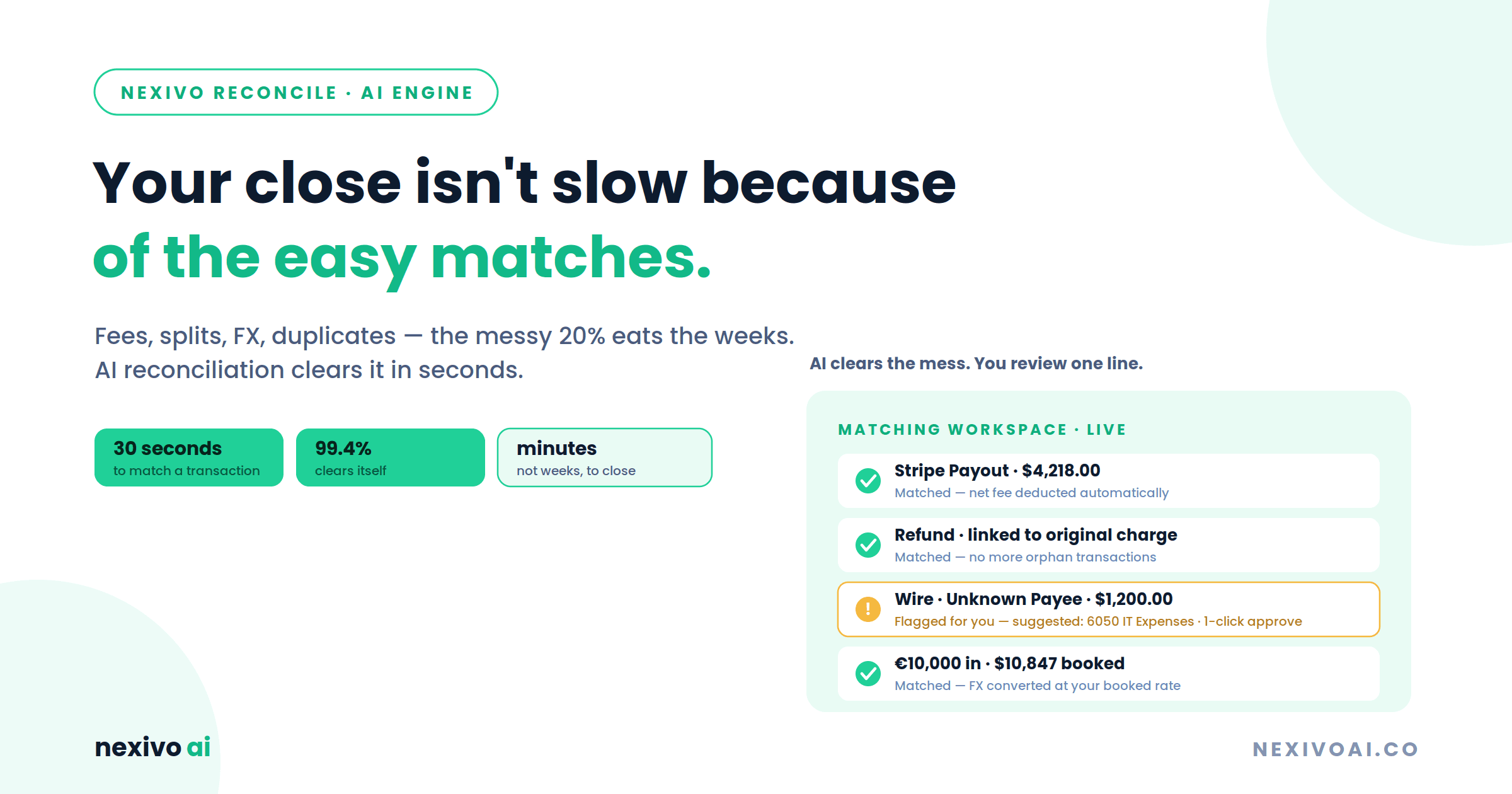
Month-end closes aren't slow because of the easy matches, a $500 invoice against a $500 deposit takes nobody's weekend. They're slow because of the messy 15–20%: processor fees, split payments, FX conversions, duplicates, and timing gaps, which break every static bank-feed rule ever written. AI reconciliation handles that messy layer by reading transaction context, learning your team's judgment, and auto-clearing only what it can match with confidence, which is how closes drop from weeks of line-by-line work to minutes of exception review.
The 80/20 rule of reconciliation misery
Ask any controller where the close actually goes, and you'll hear the same answer: not the clean matches. The overwhelming majority of transactions reconcile themselves in any competent system. The weeks disappear into the stubborn minority:
Processor fees. Stripe collects $4,391 from your customers and deposits $4,218. Your ledger says one number, your bank says another, and both are right. Multiply by every Shopify, PayPal, and Amazon Pay payout, every day.
Partial and split payments. One invoice, two wires. Or one wire covering three invoices. Amount-and-date matching has no idea what to do with either.
Multi-currency. The customer paid €10,000; your bank booked $10,847; your ledger expected $10,912. Nothing "matches," and nothing is wrong.
Duplicates and reversals. The double charge that looks identical to a legitimate repeat purchase. The reversed payment that arrives as a new line instead of an adjustment.
Refunds and chargebacks. They land weeks after the original, disconnected from it, as orphan transactions someone has to manually marry back.
Timing gaps. The deposit that's genuinely in transit versus the one that's genuinely missing, indistinguishable on a statement, very distinguishable in an audit.
Here's the structural problem: this messy minority consumes the overwhelming majority of reconciliation hours, because each case needs judgment, and judgment has traditionally meant a human with two screens and a sinking Friday feeling.
Why your bank-feed rules keep breaking
QuickBooks and Xero bank rules were a real improvement for the clean majority. But rules are static: they match on amount, date, and payee text. The moment a fee shifts the amount, a split breaks the 1:1 assumption, or an FX conversion moves the number, the rule silently fails, and the transaction lands back in the manual pile.
Worse, rules don't learn. The exception you resolved last month, the recurring vendor whose charges arrive under three different descriptors, the payout that always nets out 2.9% plus 30 cents, comes back next month as fresh work. Your team's accumulated judgment lives in their heads and their side spreadsheets, and it walks out the door with staff turnover.
What does AI reconciliation actually do differently?
Three things separate an AI matching engine from a rules engine, and all three target the messy 20% directly:
1. It reads context, not just amounts. AI reconciliation evaluates the full transaction picture: it nets out processor fees before comparing, matches one invoice against multiple partial deposits, converts FX against your booked rate, links a refund back to its original transaction, and recognizes an in-transit deposit instead of flagging every timing delay as a crisis. The messy math is the product.
2. It learns your business. Every resolved exception becomes training data. Recurring vendors clear instantly once learned. Your chart of accounts mapping is absorbed rather than re-built. The judgment call you made on a weird wire last quarter is remembered when its twin arrives next quarter. This is the part rules can never do: the system gets faster every month instead of resetting.
3. It flags what it can't clear, instead of guessing. This is the trust-critical design choice. A good AI reconciliation engine auto-clears only high-confidence matches and routes everything else to a human as a flagged exception with a suggested resolution, approve in one click or correct it (and the correction gets learned). In finance, a system that guesses wrong silently is worse than no system at all; confidence-based flagging is what makes automation auditable.
Readers of our agentic AI explainer will recognize the pattern: this is scoped, narrow agency, one workflow, clear boundaries, human judgment kept exactly where it matters. It's also why reconciliation is one of the AI use cases that actually ships while broader "AI for finance" projects stall.
The questions to ask any reconciliation vendor, including us
"Is the bank connection read-only?" A reconciliation tool needs to see transactions. It should be architecturally unable to move money. Ask directly; accept no vague answer. (Nexivo Reconcile connects through read-only Plaid; it cannot initiate transfers, full stop.)
"How do you handle fees, splits, and FX?" If the demo only shows 1:1 matches, you're watching the easy 80%, the part that was never your problem.
"What happens to unmatched transactions?" You want flagged exceptions with suggested resolutions and one-click approval, not silent guesses buried in the ledger.
"Does it learn from corrections?" If every month starts from zero, you've bought faster rules, not intelligence.
"What's the audit trail?" Every match, flag, and human decision should be logged immutably. Your auditor will ask; the software should already have answered.
What the manual hours are actually costing
Run the math on your own operation: accounts × transaction volume × hours per account. Teams reconciling several accounts by hand commonly sink 15–20+ hours a month into it; at loaded bookkeeper rates, that's real money, and at month-end stress levels, it's real attrition risk too. With a high auto-match rate (Nexivo Reconcile runs at 99.4% across 480K+ transactions for 150+ North American businesses), the same close typically collapses to an hour or two of exception review. The books don't just close cheaper; they close days earlier, which is when the numbers are actually useful for decisions.
The bottom line
Reconciliation is judgment work trapped inside repetitive work. The repetitive layer- the matching, the fee math, the duplicate hunting- is exactly what AI now does in seconds, at accuracy rates humans can't sustain at volume. What's left for your team is the part that was always theirs: the handful of genuine exceptions that deserve a human decision.
Want to see it against your own ledger? Book a free live demo of Nexivo Reconcile, it matches transactions within 30 seconds of landing
- check_circleThe close is slow because of the messy 15–20% — fees, splits, FX, duplicates, timing, not the clean matches.
- check_circleStatic bank-feed rules break precisely there, and they never learn, so the same exceptions return every month.
- check_circleAI reconciliation differs in three ways: context-aware matching, learning from your resolutions, and confidence-based flagging instead of guessing.
- check_circleThe vendor checklist: read-only access, messy-math handling, exception workflow, learning from corrections, immutable audit trail.
- check_circleThe prize isn't just saved hours — it's books that close days earlier, when the numbers can still change decisions.