Can You Trust an AI With Your Calendar and Inbox? Inside Nexivo's Trust Layer
"Can I trust an AI with my calendar and inbox?" is the right question, and "trust us" is the wrong answer. This post opens up Nexivo's Trust Layer: why Nova confirms before every action, how autonomy is earned one action type at a time, what the reversible audit log records, and the questions you should ask any AI assistant vendor, including us.

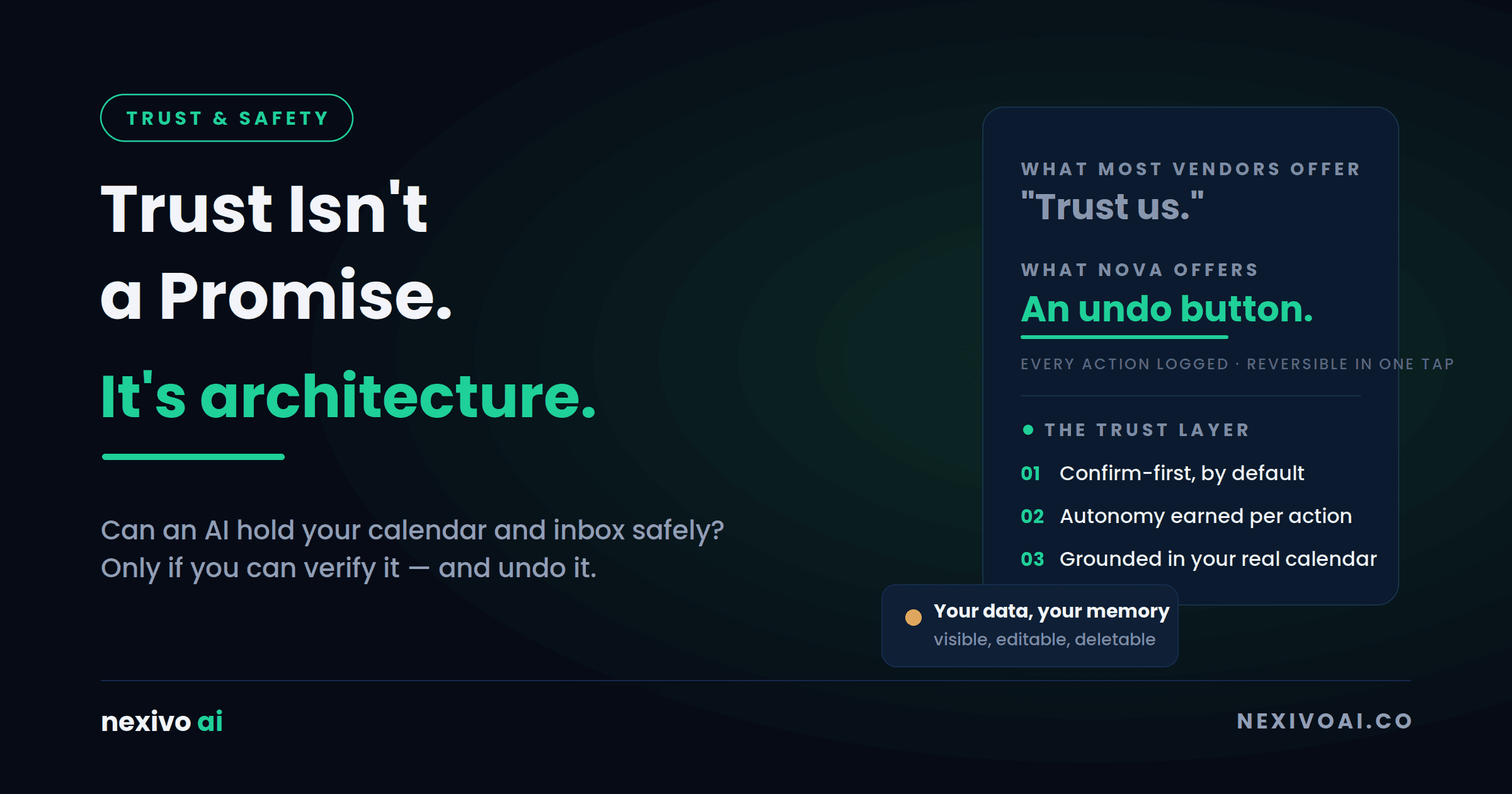
You shouldn't trust any AI with your calendar and inbox on promises alone, including ours. Trust has to be built into the architecture: confirm-first defaults, autonomy granted one action type at a time, a full audit log where every action is reversible, and grounding in your real data. That's Nexivo's Trust Layer, and this post opens it up, plus the questions you should ask any vendor, us included.
The question behind every demo
We can show Nova calling someone at 7:30 AM with their day perfectly briefed, and the first question afterward is rarely about features. It's some version of:
"Okay, but what stops it from doing something I didn't want?"
That's not paranoia. That's exactly the right question. An assistant with access to your calendar and inbox is holding your professional life: who you meet, what you promise, what you know. A chatbot that gives a wrong answer wastes a minute. An assistant that sends a wrong email spends your reputation.
So instead of dodging the question, we built our product around it. Here's how, and more importantly, how to evaluate anyone's answer to it.
"Trust us" is not a security model
The AI industry's default answer to safety questions is a promise: we're careful, we're aligned, we take privacy seriously. Promises are nice. They're also unverifiable, unenforceable, and identical from every vendor.
Our position: for AI that acts on your behalf, trust must be a property of the architecture, something you can inspect, test, and revoke. If a safety claim can't be verified from inside the product, it isn't a safety feature; it's marketing.
Nova's architecture, we call it the Trust Layer, rests on four pillars.
Pillar 1: Confirm-first, by default
Out of the box, Nova does nothing irreversible without your explicit yes. She drafts the email; you approve it. She proposes the reschedule; you confirm it. During the morning call, approval is a word: "yes, move it." In the app, it's a tap.
This sounds obvious until you audit the market: plenty of AI tools launch with autonomy on by default, treating your approval as friction to minimize. We treat it as the product working correctly. Friction at the moment of action is not a bug; it's the seatbelt.
Pillar 2: Earned Autonomy, trust granted one action type at a time
Permanent confirmation for everything would make Nova safe and exhausting. The fix isn't a master "autonomy" switch; it's granularity.
When Nova notices you've approved the same kind of action again and again, say, accepting routine meeting reschedules, she offers: "Want me to just handle these from now on?" Say yes, and that specific action type becomes automatic. Everything else stays confirm-first.
Three properties make this safe: the grant is narrow (one action type, not general autonomy), it's explicit (you said yes to a specific question, not a buried setting), and it's revocable (turn it off anytime, instantly). Autonomy is earned through your demonstrated comfort, never assumed from a terms-of-service checkbox.
Pillar 3: The audit log, every action recorded, every action reversible
Everything Nova does automatically lands in a log you can open anytime: what happened, when, and why, which grant authorized it. And every entry has an undo. Rescheduled something you didn't want moved? One tap, it's back.
We consider this the most underrated safety feature in AI, because it changes the cost of a mistake. In a system without reversibility, one bad automated action is a crisis. In a system with it, it's a correction. You can extend trust experimentally, knowing the exit is always one tap away, which, not coincidentally, is how trust between humans works too.
Pillar 4: Grounding, your calendar is the truth
Hallucination is the quiet killer of AI trust. So Nova's brain is deliberately boring: your actual calendar is the single source of truth. She never invents events, never guesses availability, never "remembers" a meeting that doesn't exist in the data. If it's not in the calendar, it's not in the briefing.
The same discipline applies to memory. What Nova learns about you, your hours, your tone, your patterns, sits in your settings: visible, editable, deletable. Memory you can't inspect is surveillance; memory you control is a feature.
And the data itself?
The unglamorous fundamentals: encrypted in transit and at rest, never sold, never used to train public models. Your professional life is the product's input, not the product.
The checklist to use on any vendor, including us
Evaluating any AI assistant? Ask these five, in writing:
- What's the default action mode: autonomous, or confirm-first?
- How granular are permissions: one master switch, or per action type?
- Is there an audit log, and is every action reversible?
- What's the data policy, retention, selling, model training?
- Can I see, edit, and delete what it remembers about me?
Any vendor who answers all five clearly deserves your evaluation. Any vendor who won't has answered a different question.
The bottom line
The question was never "can you trust AI?", it's "does this product make trust verifiable?" Promises age badly; architecture doesn't.
- check_circleTrust must be architectural, not promised. If a safety claim can't be verified from inside the product, it's marketing, not a feature.
- check_circleConfirm-first is the right default. Nothing irreversible should happen without your explicit yes — friction at the moment of action is the seatbelt, not a bug.
- check_circleAutonomy should be earned, narrow, and revocable. Grant automation per action type, after demonstrated comfort — never through one master switch.
- check_circleReversibility changes the cost of a mistake. A full audit log with one-tap undo turns a bad automated action from a crisis into a correction.
- check_circleGrounding kills hallucination risk. Your real calendar as the single source of truth means no invented events, ever — and memory you can see, edit, and delete.
- check_circleUse the five-question checklist on every vendor — default action mode, permission granularity, audit log and reversibility, data policy, and memory visibility.