AI Executive Assistant vs Human EA: Cost, Capabilities, and When You Need Which (2026)
Human executive assistants bring judgment and relationships; AI executive assistants bring 24/7 availability, perfect memory, and a fraction of the cost. This guide compares the two across six dimensions, cost, availability, capabilities, judgment, scale, and trust, and shows when each wins, and why many executives are landing on a hybrid.

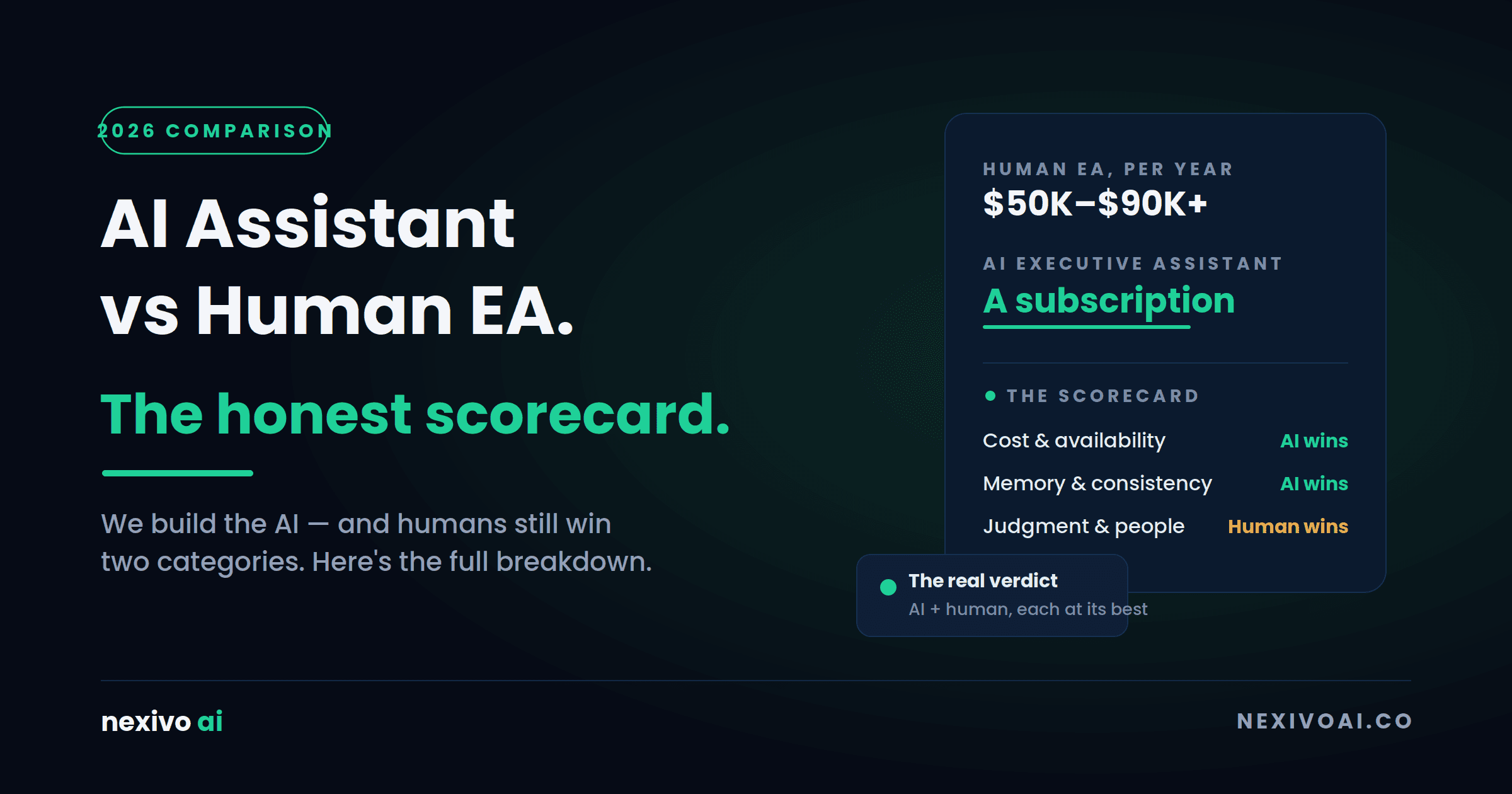
A human EA wins on judgment, relationships, and physical-world tasks. An AI executive assistant wins on cost (a subscription vs $50,000-$90,000+ a year), availability (24/7), and memory (perfect recall). Solo founders and executives who've never had an EA gain the most from AI; leaders with heavy stakeholder management keep the human and hand the mechanical layer to AI. Full comparison below.
First, a disclosure
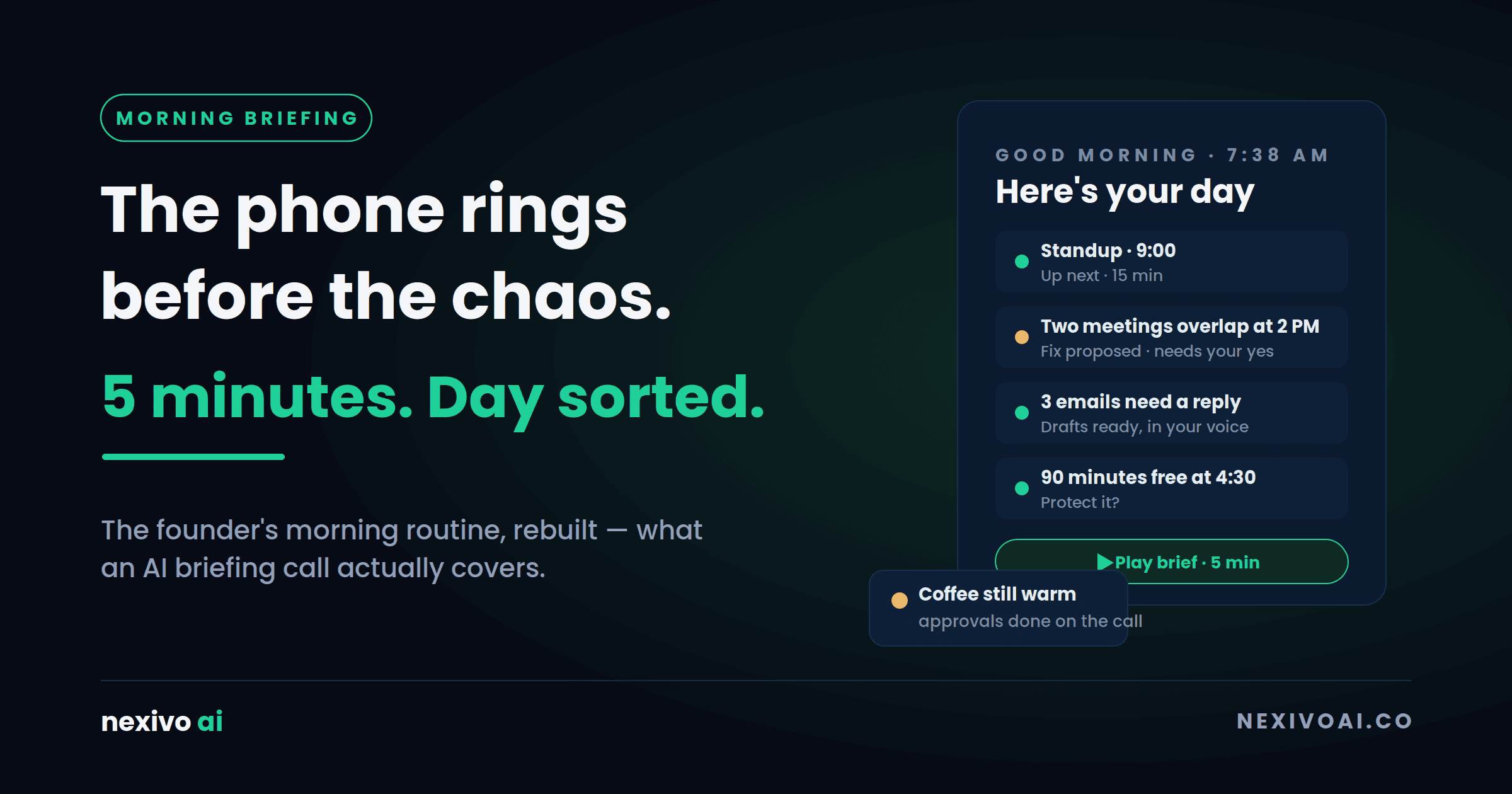
We build an AI executive assistant, Nova, who calls you every morning with a five-minute briefing of your day. So you'd expect this comparison to end with "AI wins, obviously."
It doesn't. Human assistants beat software in at least two categories, and pretending otherwise would tell you we don't understand the job.
Here's the honest breakdown, factor by factor.
Factor 1: Cost, AI wins, and it isn't close
A full-time executive assistant in the US typically costs $50,000-$90,000 a year in salary; senior EAs in major metros clear six figures, plus benefits, recruiting, onboarding, and the management attention every employee needs.
An AI executive assistant is a software subscription. Nova starts with a 14-day free trial and no card, and even at full price the annual cost is a rounding error against a human salary. For the majority of professionals who could never justify a human EA, this factor alone changes who gets an assistant at all.
Factor 2: Availability, AI wins
Your human assistant sleeps, takes weekends, gets sick, and goes on holiday, as they should. Your AI assistant briefs you at 7:30 AM on a Sunday if that's what you want, watches your inbox at midnight, and never has a handover gap. For executives operating across time zones, this is the difference between coverage and coverage-with-holes.
Factor 3: Memory and consistency, AI wins
Even brilliant human assistants lose context: the promise you made in March, the thread that went quiet in a busy week. An AI assistant's memory is structural. Nova remembers your working hours, your writing voice, the commitment you made on a call six weeks ago, and, importantly, that memory stays visible, editable, and deletable by you. Nothing slips because nothing is forgotten.
Factor 4: Judgment and relationships, humans win
Now the other side. A great EA reads a room. They know which investor gets the warm intro and which gets the polite delay, when "the calendar is full" actually means "he doesn't want this meeting," and how to soothe a furious client before you've even heard about the problem. That's social intelligence built on years of human context, and no AI, ours included, replicates it today. If your assistant's core value is managing people rather than managing time, the human stays.
Factor 5: The physical world, humans win
Someone has to sign for the package, arrange the office, sit in the meeting, and take the temperature of the room. Software doesn't do errands. This sounds trivial until it's your reality.
Factor 6: Trust and control, a draw, decided by design
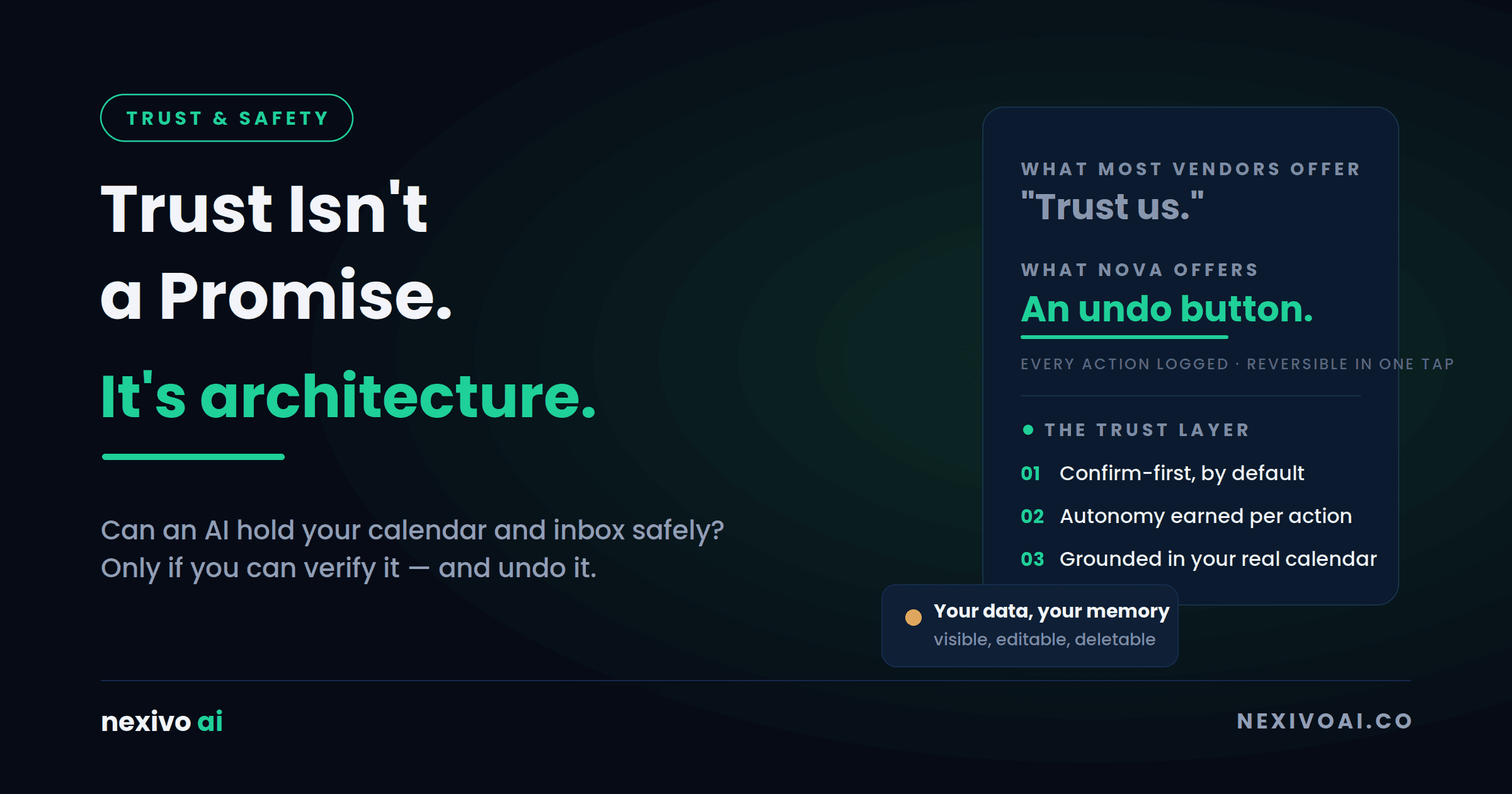
Handing your calendar and inbox to anyone, human or AI, is an act of trust. With humans, trust builds through relationship. With AI, it has to be built through architecture: Nova confirms before every action by default, grants automation only per action type as you approve patterns (we call it Earned Autonomy), and records every automated move in an audit log you can reverse in one tap. A human EA can't offer you an undo button. Good AI must.
So which one do you need?
You've never had an assistant: AI, unambiguously. You're not choosing between a human and software; you're choosing between software and nothing. The mechanical layer of your day- scheduling, triage, reminders, prep- is exactly what AI already handles, at a price that makes the decision easy.
You have a great EA: Keep them, and give them AI. The winning pattern we see isn't replacement; it's reallocation: the AI absorbs the mechanical work (calendar hygiene, inbox triage, morning briefings), freeing your human assistant for the judgment work only they can do. Your EA becomes more valuable, not less.
You're between the two: Start with AI, and let the pain tell you if you need more. If after three months your bottleneck is social, stakeholders, events, relationship management, hire the human. If it was mechanical, you've already solved it.
The bottom line
The question was never really "AI or human." It's "which parts of the job does each do best?" The mechanical layer of executive support has quietly become software's job. The human layer hasn't, and honest AI companies should say so.
- check_circleAI executive assistant vs human assistant
- check_circleshould I hire an EA or use AI
- check_circleAI chief of staff
- check_circlevirtual assistant alternatives